UMAP
Uniform Manifold Approximation and Projection: a fast non-linear embedding that preserves both local and some global structure. An independent C++ port (BSD-3 attribution in the source header).
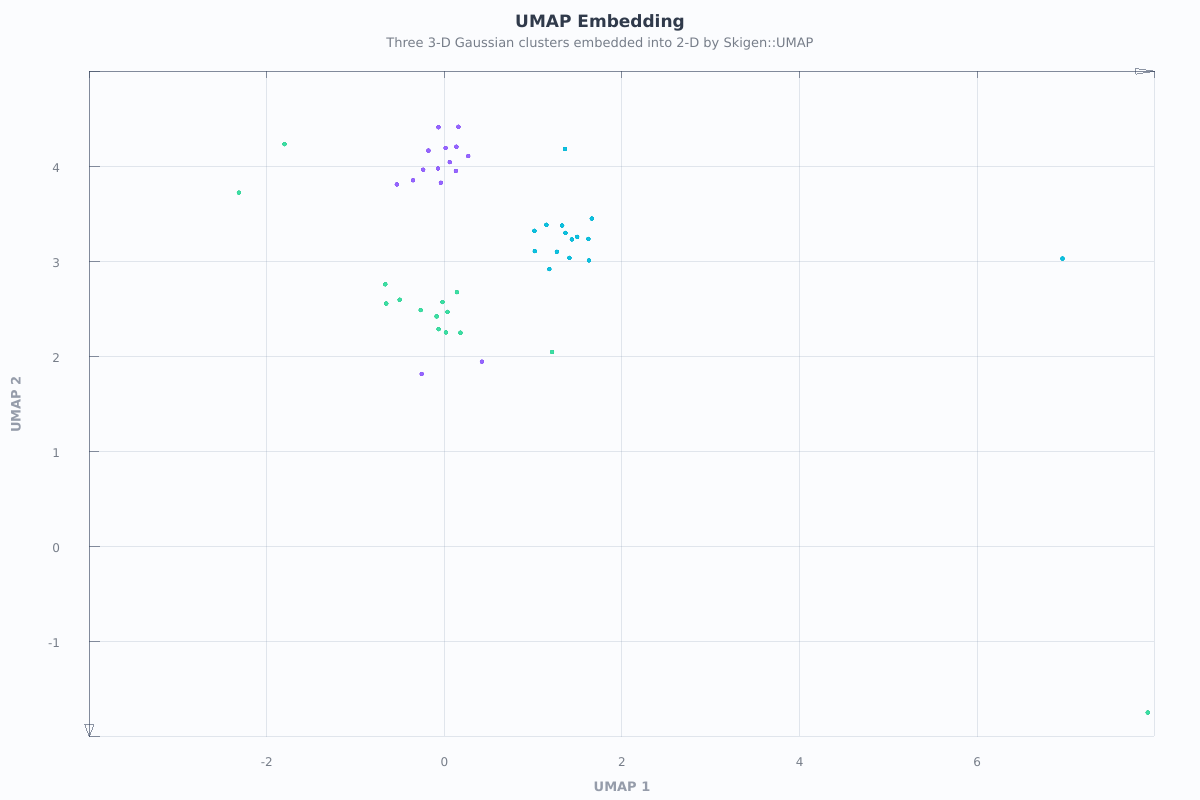
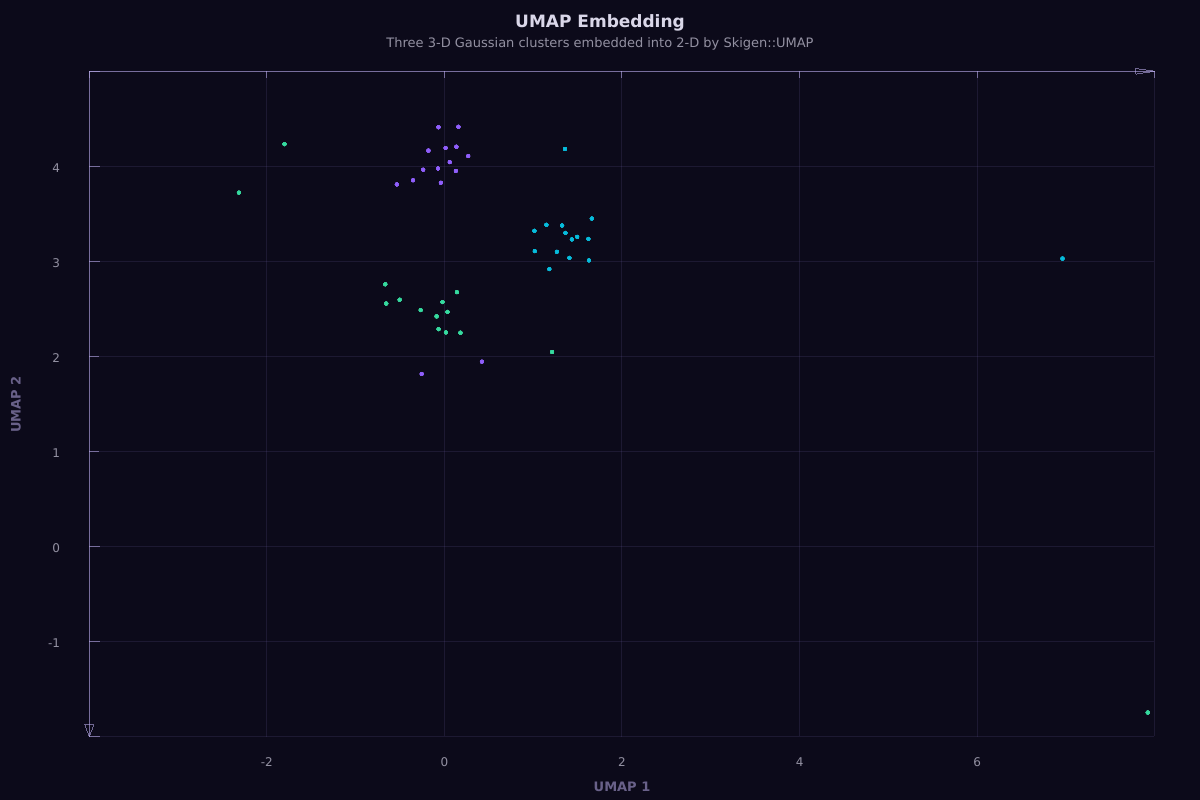
The examples/manifold/umap.cpp program embeds three synthetic 3-D clusters into two dimensions:
Algorithm
Builds a fuzzy topological representation of the data via local fuzzy simplicial sets, then optimises a low-dimensional layout by stochastic gradient descent on the cross-entropy between the two fuzzy structures.
Constructor
Skigen::UMAP<Scalar> model(int n_components = 2, int n_neighbors = 15, Scalar min_dist = 0.1, Scalar spread = 1.0, int n_epochs = 0, int negative_sample_rate = 5, uint64_t random_state = 0);
Parameters
| Parameter | Default | Description |
|---|---|---|
n_components | 2 | Embedding dimensionality. |
n_neighbors | 15 | Local neighbourhood size. |
min_dist | 0.1 | Minimum spacing in the embedding. |
spread | 1.0 | Scale of embedded points. |
Methods
| Method | Description |
|---|---|
fit_transform(X) | Return the embedding. |
Fitted Attributes
| Accessor | Description |
|---|---|
n_iter() | Optimisation epochs run. |
Example
Skigen::UMAP<double> umap(2, 15);
auto Y = umap.fit_transform(X);
This estimator is checked by the parity suite. See the generator tests/parity/generate_manifold_reference.py and the reference fixtures in tests/parity/data/umap/, exercised by tests/parity/parity_manifold.cpp.
For full signatures see the UMAP API Reference.