TSNE
t-distributed Stochastic Neighbor Embedding: a popular non-linear method for visualising high-dimensional data in 2-D/3-D.
The examples/manifold/tsne.cpp program embeds three 4-D Gaussian clusters into 2-D and renders them with SkigenPlot:
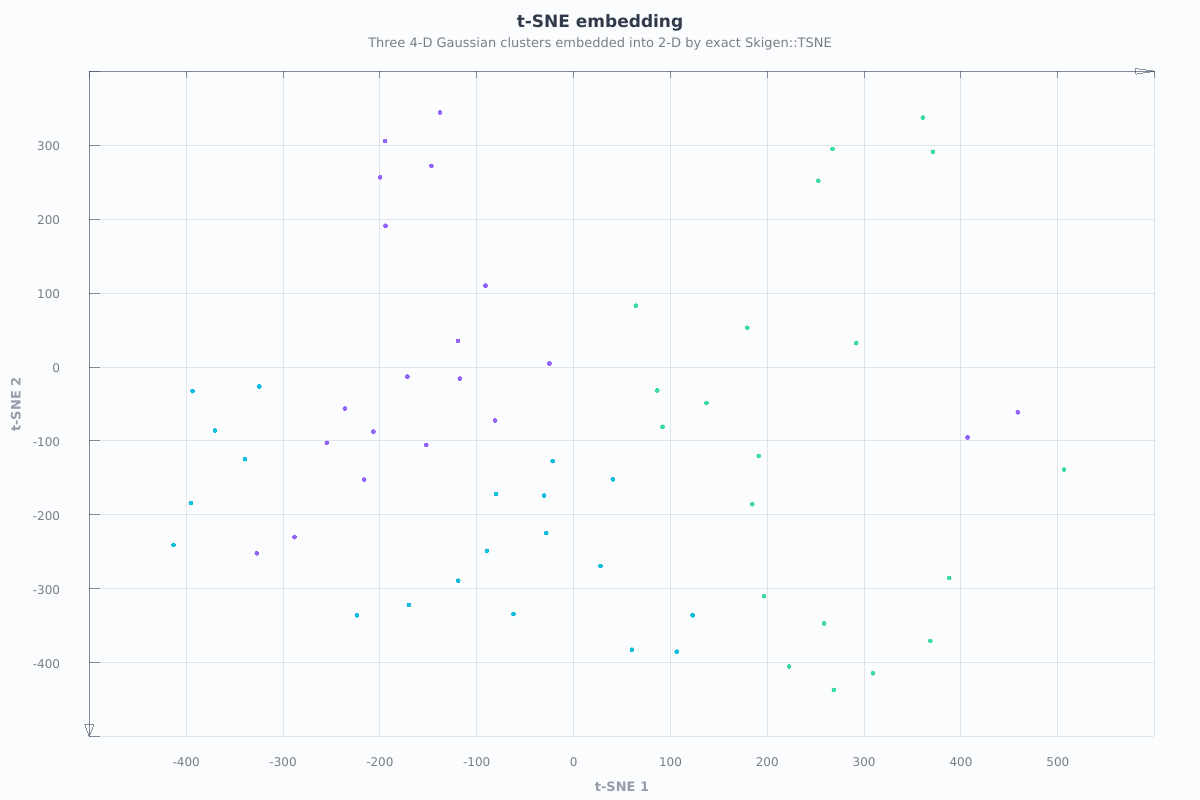
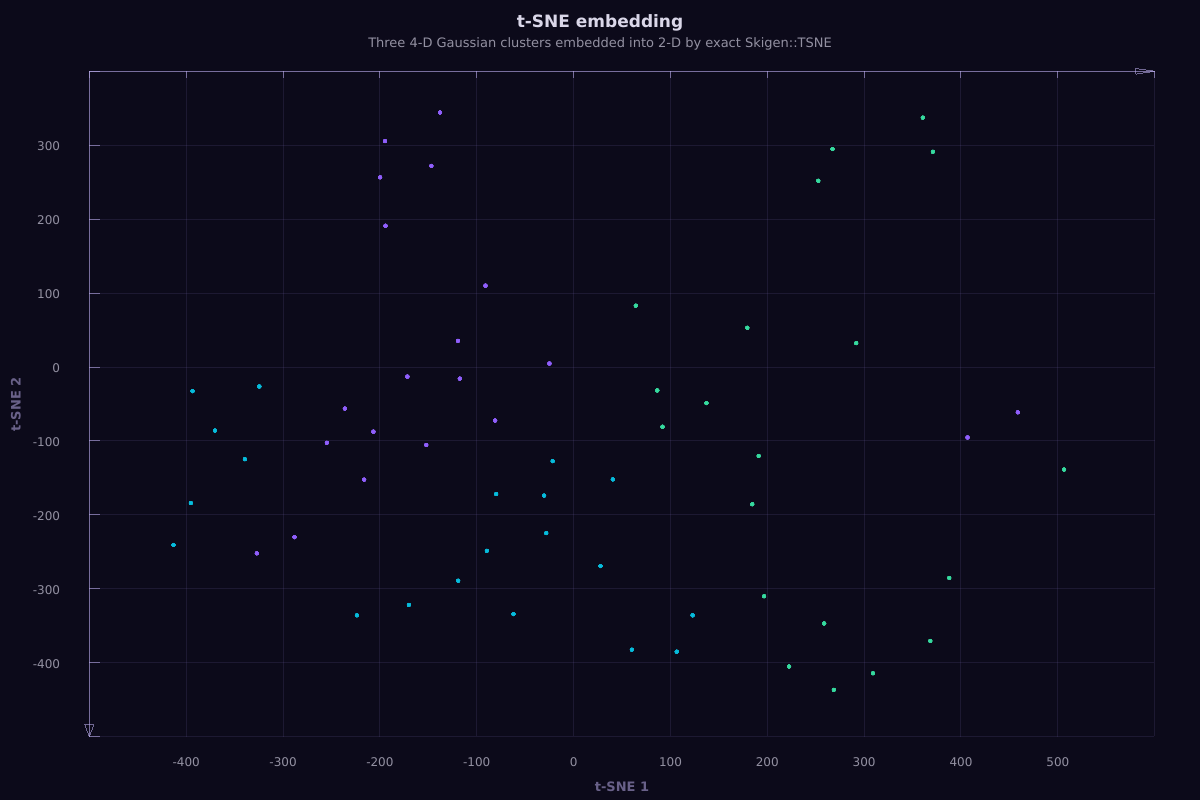
Algorithm
Models pairwise similarities as conditional probabilities in both spaces and minimises their KL divergence by gradient descent, using a heavy-tailed Student-t kernel in the embedding to avoid crowding.
Two optimisation methods are available:
"exact"— the dense gradient. Most accurate, suitable for small datasets."barnes_hut"(default) — for 2-D embeddings, the repulsive forces and the Student-t normalisation constant are approximated with a quadtree (van der Maaten, JMLR 2014), reducing the per-iteration cost to . Theangleparameter trades accuracy for speed: a cell is summarised by its centre of mass when . Forn_components != 2the estimator automatically falls back to the exact method.
Constructor
Skigen::TSNE<Scalar> model(
    int n_components = 2,
    Scalar perplexity = 30.0,
    Scalar learning_rate = 200.0,
    int n_iter = 1000,
    std::string method = "barnes_hut",
    Scalar angle = 0.5,
    Scalar early_exaggeration = 12.0,
    std::optional<uint64_t> random_state = std::nullopt);
Parameters
| Parameter | Default | Description |
|---|---|---|
n_components | 2 | Embedding dimensionality. |
perplexity | 30.0 | Effective neighbourhood size. |
learning_rate | 200.0 | Gradient-descent step size. |
n_iter | 1000 | Optimisation iterations. |
method | "barnes_hut" | "barnes_hut" (O(n log n), 2-D) or "exact" (O(n²)). |
angle | 0.5 | Barnes-Hut accuracy/speed trade-off. |
early_exaggeration | 12.0 | P-scaling during the first 250 iterations. |
Methods
| Method | Description |
|---|---|
fit_transform(X) | Return the embedding. |
Fitted Attributes
| Accessor | Description |
|---|---|
kl_divergence() | Final KL divergence. |
method() | Method actually used ("barnes_hut" or "exact"). |
Example
Skigen::TSNE<double> tsne(2, 30.0);
auto Y = tsne.fit_transform(X);
Verified against scikit-learn
This estimator is checked by the parity suite. See the generator tests/parity/generate_manifold_reference.py and the reference fixtures in tests/parity/data/tsne/, exercised by tests/parity/parity_manifold.cpp.
API Reference
For full signatures see the TSNE API Reference.