SVC
Kernel support-vector classifier built on a libsvm-style SMO solver, supporting linear, RBF, polynomial and sigmoid kernels.
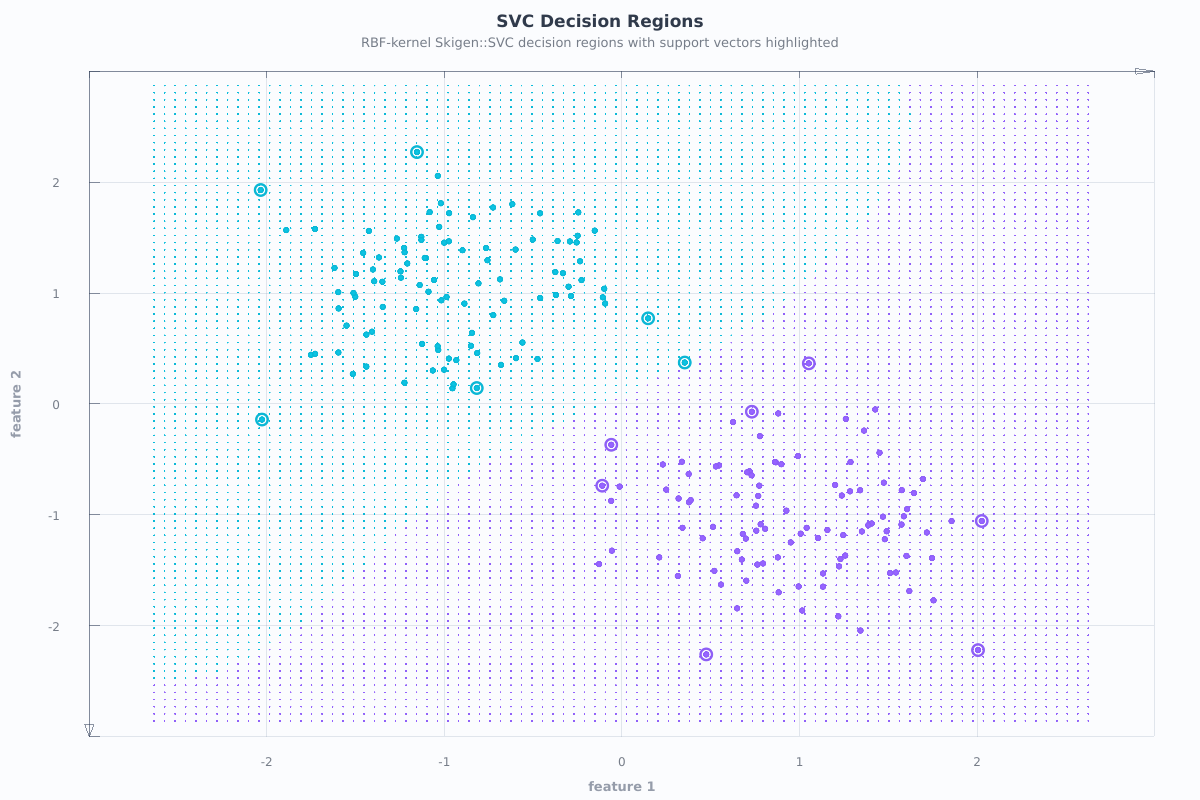
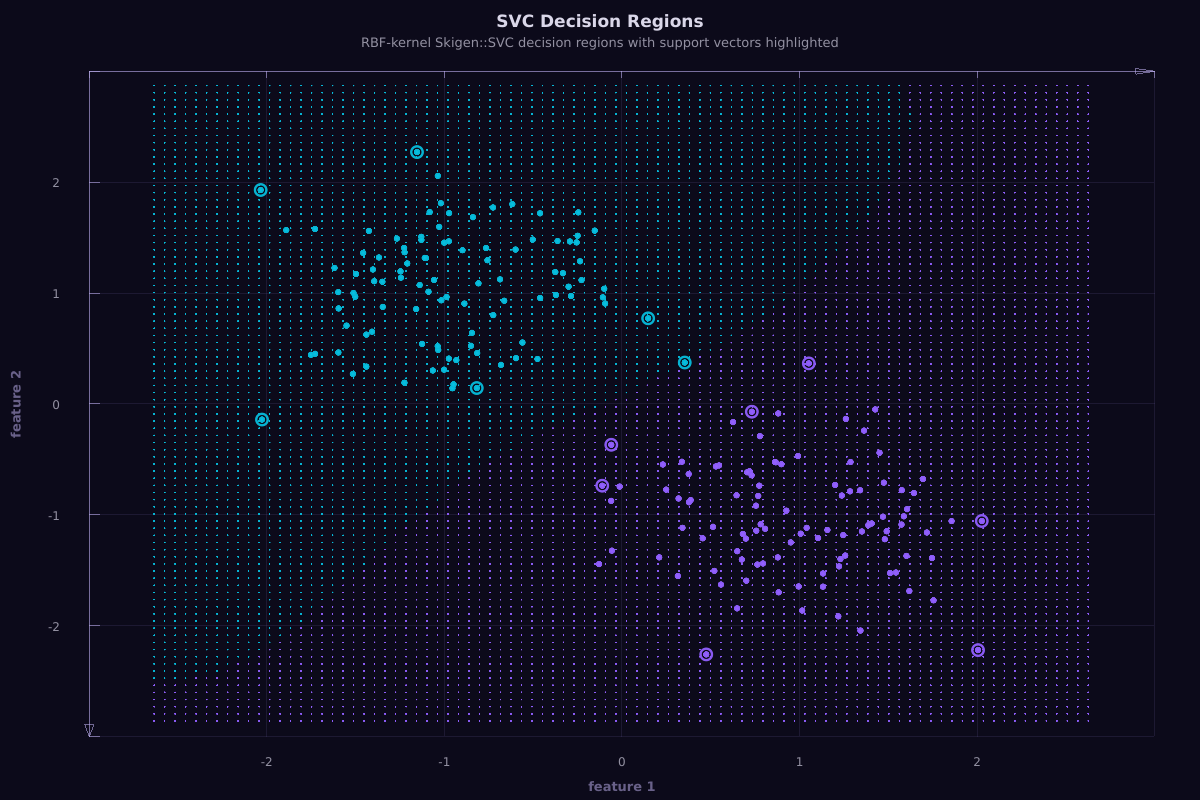
The examples/svm/svc.cpp program fits an RBF classifier on two Gaussian classes and renders its decision regions with support vectors highlighted:
Algorithm
Sequential Minimal Optimization solves the dual quadratic program, selecting working pairs and updating their Lagrange multipliers until the KKT conditions hold. Multiclass uses one-vs-one voting. With probability=true, Platt scaling calibrates the margins into probabilities via internal cross-validation.
Constructor
Skigen::SVC<Scalar> model(Scalar C = 1.0, Kernel = RBF, int degree = 3, Scalar gamma = scale, ...);
Parameters
| Parameter | Default | Description |
|---|---|---|
C | 1.0 | Penalty on margin violations. |
kernel | RBF | Linear, RBF, Poly or Sigmoid. |
degree | 3 | Polynomial-kernel degree. |
gamma | scale | Kernel coefficient. |
probability | false | Enable Platt-scaled probabilities. |
Methods
| Method | Description |
|---|---|
fit(X, y) | Solve the dual via SMO. |
predict(X) | Class labels. |
decision_function(X) | Margins (OvO for multiclass). |
predict_proba(X) | Requires probability=true. |
Fitted Attributes
| Accessor | Description |
|---|---|
n_support() | Support vectors per class. |
n_classes() | Number of classes. |
Example
Skigen::SVC<double> svc(1.0, Skigen::SVC<double>::Kernel::RBF);
svc.fit(X, y);
auto preds = svc.predict(X_test);
This estimator is checked by the parity suite. See the generator tests/parity/generate_svm_reference.py and the reference fixtures in tests/parity/data/svc/, exercised by tests/parity/parity_svm.cpp.
For full signatures see the SVC API Reference.